Editorial
Sell ads. Report the news.
Yesterday, I saw a Star Tribune post on LinkedIn about Fairview St. John’s Hospital. It described the hospital’s expansion, its history in the community and its accomplishments. It was a positive story, published under the newspaper’s name.
It was also an advertisement.
The post opened with “This post is provided by Fairview Health Services.” A small line at the bottom of the accompanying image disclosed that Fairview sponsored the content through the Star Tribune’s MN RISING initiative.
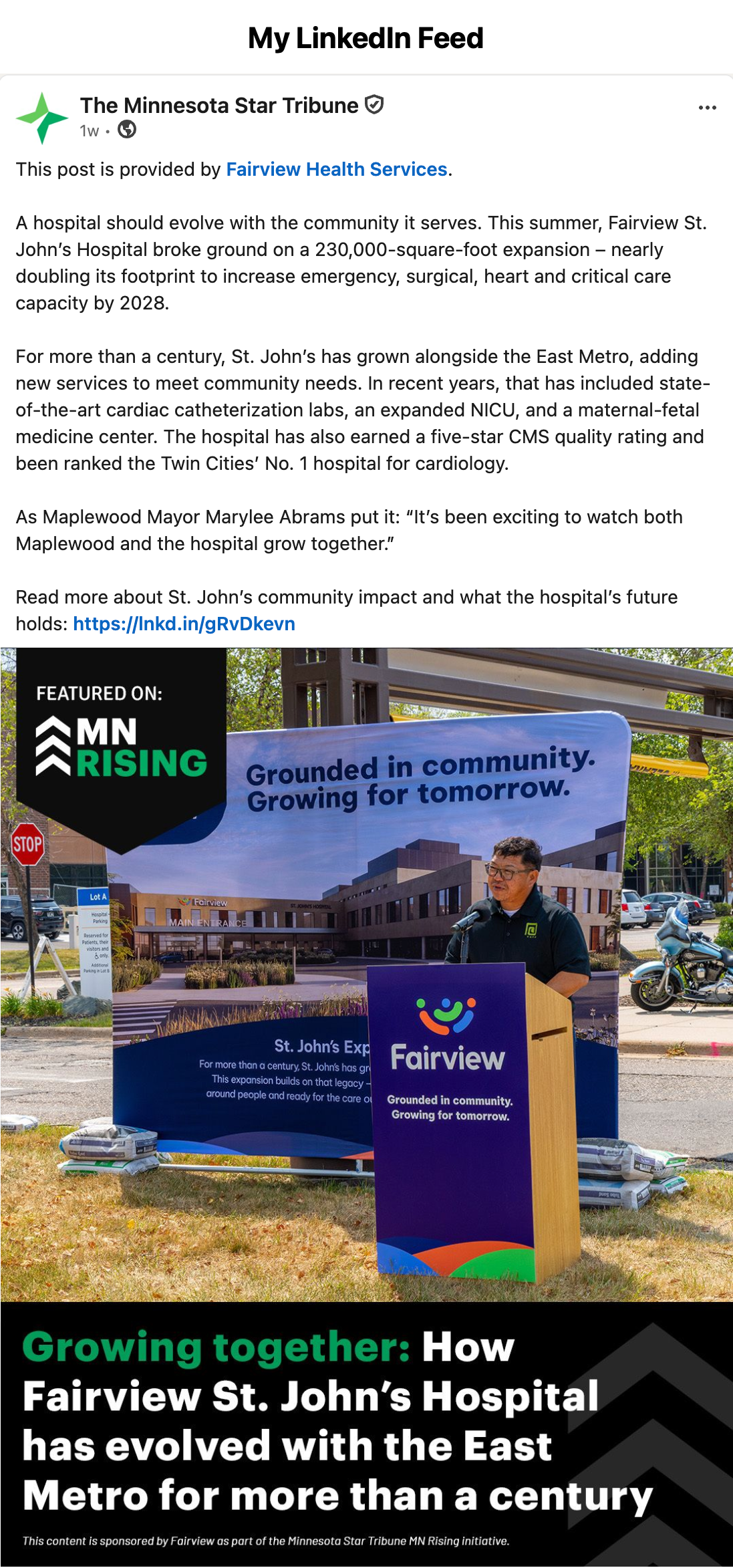
Advertisement — Star Tribune’s Fairview post on LinkedIn. Screenshot captured September 29, 2026.
This morning, I saw the Star Tribune on Facebook sharing a story about what a HealthPartners–Essentia merger means for consumers and Minnesota healthcare.
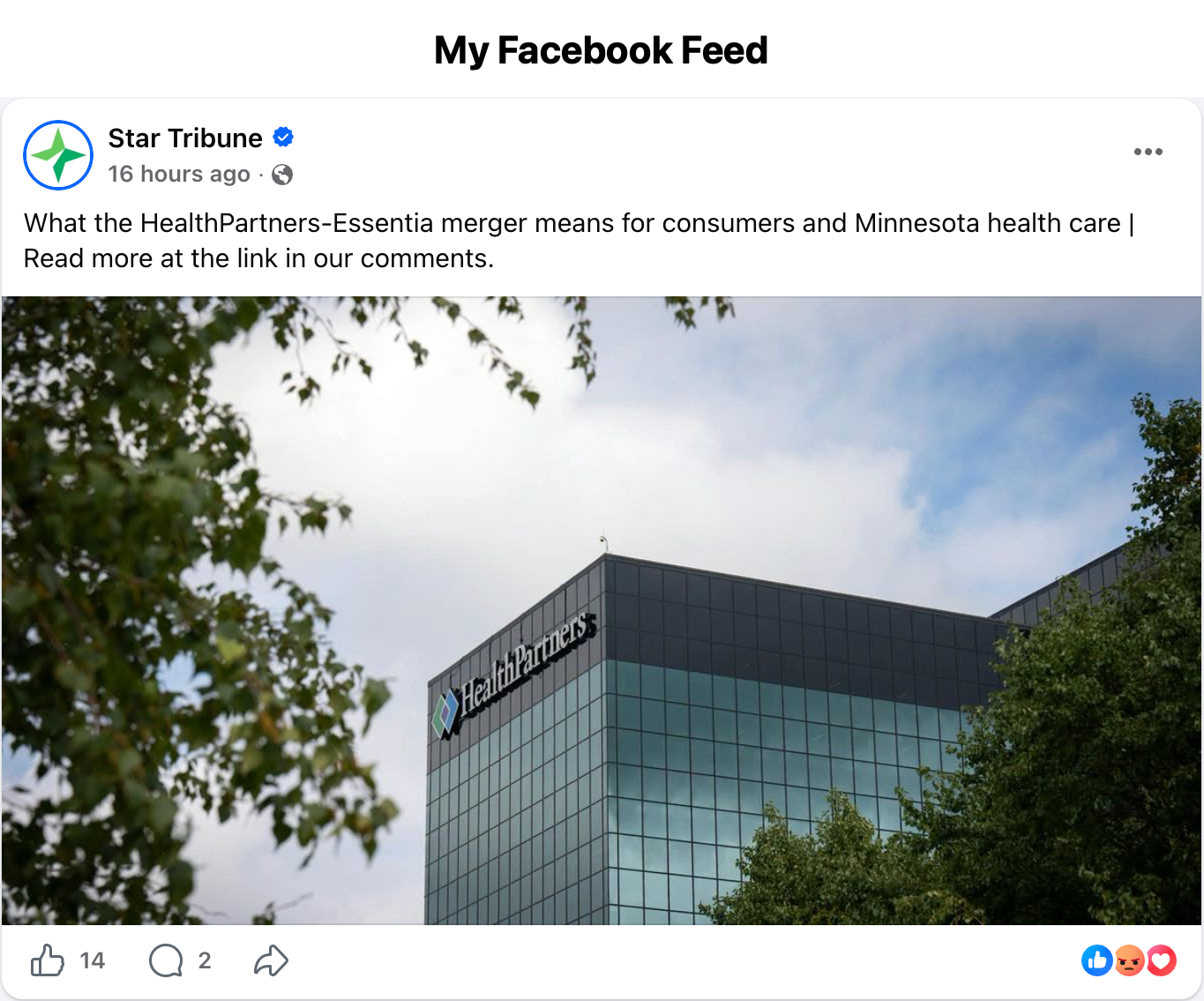
Reporting — Star Tribune’s healthcare merger post on Facebook. Screenshot captured September 30, 2026.
Seeing those two posts prompted questions for me. Here was the newspaper promoting one healthcare organization, then asking me to trust its reporting on others.
I want to read healthcare coverage and consider the evidence. I don’t want to begin by wondering how the newspaper’s commercial relationships might intersect with the institutions being covered.
When an ad looks like a story
There’s a name for this kind of promotion: native advertising. Instead of appearing as an obvious advertisement, it takes the form of something you might ordinarily read from the publisher—a story, a feature or a social media post.
The distinction is who it serves. Independent journalism starts with an editorial decision about what deserves coverage and what readers need to know. An advertisement serves the organization paying for it, even when it tells a true story about something worthwhile.
A hospital expansion may be good news. It may also deserve reporting. But a promotional account of that expansion serves a different purpose from a reporter examining what it will mean for patients, costs or access to care.
That difference gets harder to recognize when both arrive under the same newspaper’s name.
The Fairview post did disclose its sponsorship. My objection isn’t that there was no label. It’s that the newspaper is selling a promotional story wrapped in the identity readers associate with its journalism.
Why healthcare makes this matter
We all depend on independent state and local journalism. Most of us don’t have the time, access or resources to investigate the institutions making decisions that affect our communities.
Healthcare is an area where we need that work. Mergers and other major changes deserve questions about affordability, access, competition and what happens to the people receiving and providing care. We need someone to examine the promises and keep asking questions after the announcements are over.
That is what I look to the newspaper to do.
The Facebook post about the merger was a reporting post. I’m not suggesting it was an advertisement, and these screenshots don’t show that anyone influenced the reporter’s work.
They show what made me hesitate.
After seeing the newspaper carry Fairview’s promotional message, I found myself questioning its healthcare coverage before I had even opened the next article. I don’t know whether its commercial relationships affect that coverage. But the newspaper’s choice to mix these roles has given me a reason to wonder.
That costs something. Reader trust is part of what makes journalism useful.
A label doesn’t settle the question
I started with a concern about disclosure. “Provided by” could be clearer, and small print at the bottom of an image is easy to miss.
But even a large “Paid advertisement” label would leave me asking why a newspaper wants to be in the business of producing and distributing promotional stories for institutions it also covers.
I understand that newspapers need advertising revenue. I expect to see ads. A clearly recognizable Fairview advertisement would not have prompted the same reaction.
What troubles me is the newspaper lending its own credibility to the promotion. Fairview can tell its story in its own voice. The Star Tribune should decide independently whether that story deserves coverage, what needs examining and whose voices are missing.
Readers should be able to recognize those different roles without studying the fine print.
News organizations should get out of the native advertising business. They should make advertising clearly recognizable and preserve journalism as the product of independent editorial judgment.
We need that distinction especially now, when consequential healthcare decisions demand careful public scrutiny.
Sell ads. Report the news. Stop making readers untangle the two.